
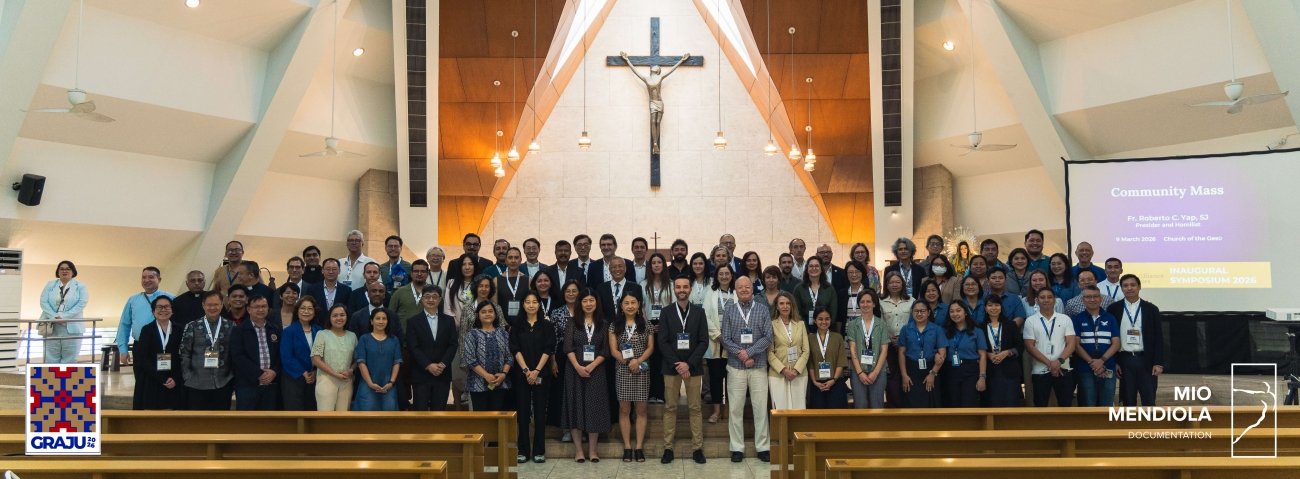
Scholars and research leaders from Jesuit universities around the world gathered in Manila for the Inaugural Symposium of the Global Research Alliance of Jesuit Universities (GRAJU), marking a significant step toward deeper international collaboration on artificial intelligence research and its implications for higher education and society.
Hosted by Ateneo de Manila University from 9 to 12 March 2026, the symposium brought together delegates from Jesuit institutions across multiple continents to explore how artificial intelligence can be developed and applied in ways consistent with the Jesuit tradition of scholarship in service of the common good.
The symposium opened with the celebration of the Eucharist at the Church of the Gesù, presided over by Fr Roberto C Yap SJ, President of Ateneo de Manila University. The liturgy set the tone for the gathering, emphasizing reflection, discernment, and a shared mission among participating universities.

Following the Mass, delegates formally launched the symposium with opening remarks highlighting the importance of global academic collaboration in addressing complex challenges. Jeffrey Urbach PhD, Vice Provost for Research at Georgetown University, underscored the role of international research partnerships in responding to emerging technological and societal questions.
The inaugural address was delivered by Fr Fernando Ponce León SJ, who reflected on the mission of Jesuit universities in advancing research grounded in faith, justice, and service. He encouraged institutions to deepen collaboration and pursue scholarship that responds to the needs of the world.
The symposium’s first keynote was delivered by Olivier Sylvain PhD, whose address examined the evolving relationship between technology, governance, and the digital public sphere. His talk invited participants to consider how emerging technologies such as artificial intelligence are reshaping public discourse, institutional responsibility, and the regulatory frameworks that guide the digital age.
Delegates also visited Quezon City Hall, where Hon Joy Belmonte, Mayor of Quezon City, hosted a presentation on the city’s use of artificial intelligence and data-driven technologies in governance and public service. The visit offered participants a concrete example of how technological innovation can directly benefit communities.
Across the symposium’s sessions, scholars examined a wide range of topics including artificial intelligence in research and creative work, the ethical and legal implications of generative AI, and the integration of AI within Ignatian pedagogy and curriculum design.
The second keynote address featured Susan Kennedy PhD, who delivered the Kwan Laurel Lecture in the Humanities. Her presentation explored how generative AI is reshaping ideas of authorship, intellectual property, and scholarly recognition.
On the symposium’s final day, Maria Mercedes T Rodrigo PhD, Head of the Ateneo Laboratory for the Learning Sciences, delivered a keynote on opportunities for joint research and innovation among Jesuit institutions. Her presentation examined how AI can support students, educators, and institutional systems while identifying areas where collaborative research could advance shared priorities.
Participants also engaged in concurrent research presentations, innovation showcases, and one-on-one research conversations designed to foster deeper collaboration and exchange of ideas across institutions. These sessions enabled scholars to explore emerging research directions and potential partnerships within the global Jesuit academic network.

The symposium concluded with a closing ceremony. Maria Luz Vilches PhD, Vice President for Higher Education at Ateneo de Manila University, thanked delegates and organizers for the productive exchange of ideas over the three-day gathering.
During the closing program, George Z Hong PhD, Chief Research Officer and Associate Provost for Research at Fordham University, shared updates from the GRAJU business meeting and announced that the next GRAJU Symposium will be hosted by the University of Deusto in Spain.
In a closing toast, Fr Yap expressed hope that the conversations and collaborations initiated during the symposium would inspire continued reflection on how artificial intelligence can be harnessed responsibly within Jesuit higher education to advance academic excellence and contribute to the greater good.

The GRAJU Inaugural Symposium represents an important milestone in strengthening global partnerships among Jesuit universities, affirming their shared commitment to collaborative research that addresses emerging technological challenges while remaining grounded in the values of justice, ethics, and service.